Showing posts with label science. Show all posts

Thursday, July 5, 2012

Discovery of the Higgs Boson

You should already know by now that CERN is calling a discovery on the Higgs boson. Probably the best coverage I've read yet is at the New York Times.
This is exciting stuff, not because they've essentially confirmed a theory, but because it may lead them to further discovery and understanding as the LHC is ramped up to full power.

Saturday, July 30, 2011

Earth Trojan Asteroid

This Earth trojan asteroid has been recently discovered. Trojan objects typically orbit one of the stable Lagrange points, L4 and L5, and to a lesser degree L1, L2, L3. I posted a cool animation showing this for Jupiter previously. What's interesting about this find is that it seems this asteroid is in a weird oscillating orbit moving between L3 and L4. I've never heard of anything doing that before, but orbital mechanics gets very chaotic in actual space with lots of other planets and the moon around. The simple theory of the Lagrange points is all well and good, but this looks just weird.

Sunday, February 6, 2011

NASA STEREO Super Sun Day.

Today, NASA's STEREO spacecrafts, A, and B, will be on exactly opposite sides of the sun, and will be taking pictures of its entire surface at the same time. These spacecraft have been travelling round Earth's orbit in opposite directions since October 2006, providing stereo vision of the Sun. Super Sun Day! More at the main site.
Update: and here it is. Cool.

Wednesday, November 24, 2010

Freeman Dyson on Global Warming

I've just found a very interesting lecture by the legendary physicist Freeman Dyson.
There is a video here, and some of the text here.
My favourite contribution from Dyson is of course the Dyson Sphere.
Anyway, in this lecture from 2005, he is reminding us that heretics in science are important and that we shouldn't always blindly believe the common popular view. He goes on to try to put the problems of global warming into some perspective to try to pull us away from the current popular hysteria in the media. It really is worth a read.
(thanks to Neal Asher who linked this recently)

Sunday, July 25, 2010

The Greatest Show on Earth

I just finished reading The Greatest Show on Earth, by Richard Dawkins.This is Dawkins latest book in which he outlines the evidence for evolution. When you hear this, you might think that
a) Hasn't he done this before? and
b) Surely this is a done deal, why is he banging on about it?
To answer a), previously he has outlined the how of evolution (Climbing Mount Improbable), why evolution is a better fit to explain history than God (The Blind Watchmaker), and some books about how genes work (The Selfish Gene and The Extended Phenotype) but this one goes through the existing evidence for evolution being actually true, whereas in the other books it is taken as an assumption.
To answer b), and he covers this in depth, that in particular in the USA, around 40% of people don't believe in evolution at all, and even in many other Western countries it can be around 20%. That is unnerving.
So if you are interested in how we know that evolution actually occurred, this book takes you through in usual Dawkins glorious detail what the evidence actually is, and that it doesn't all hinge on a few fossils. I was quite interested to go through the whole Missing Link counter argument and see that there just aren't any, and that we actually have a really good fossil-record coverage.
Some of the arguments against the Intelligent Design theory are quite amusing. I was fascinated to learn about a particular laryngeal nerve (brain to larynx) that in all mammals, runs from the brain, wraps round near the heart and goes back up the neck to the larynx. There's a good evolutionary explanation for why this is so, but if you attributed it to a designer, it would be more a case of Unbelieveably Stupid Design. Think Giraffe.
Then there is the decade long experiment showing some bacteria actually evolving, showing them becoming more efficient at consuming glucose, and even evolving the ability to consume a citrate for energy in restricted resource conditions. Amazing stuff.
I'll admit that I did speed read and skip over some sections, because he's really preaching to the converted, but to get into actual detail about things like the above, and radioactive clocks, carbon dating etc was really interesting.

Wednesday, March 24, 2010

7 TeV Day

March 30 is 7 TeV day.
It seems a very complex process getting LHC set up just right, so I wouldn't be surprised if there are some delays, but it should be damn exciting for those involved. Of course, the LHC is rated up to 14 TeV collisions, but they are restricting themselves to half for this year to make sure they get some results without things going boom again.
Get the daily inside news here. It's pretty terse though.

Tuesday, February 2, 2010

New metal foam

Oooh! This metal foam has the strongest strength to density ratio yet, and "It can compress up to 80% of its original size under loading and still retain its original shape". Cool. Useful. Hmmm.

Moon Landing Cancelled.

Good. Personally I think we're better investing time and money into the ISS, encouraging commercial spaceflight, and other orbital capital like fuel depots. What about spun gravity in earth orbit? That's going to be way more comfortable than being on the moon in one sixth gravity. OK, you need a large diameter for the centrifuge, but the spokes don't have to be traversable to keep the cost down.

Friday, January 29, 2010

Fusion steps forward

Dr Glenzer of the National Ignition Facility (Nif) in the US thinks they can get a fusion ignition happening this year. They are using 192 lasers to heat a fusion ready pellet of fuel to the point of fusion. They've just passed an important step and got the supplied energy up to 669 kiloJoules, and he suggests all they need is 1200  kiloJoules.
More here.

Friday, January 15, 2010

The Earth is plunging toward the Sun!

At least this theory suggests it might be.
In short, the Sun is collecting dark matter on its journey through space, increasing its apparent mass, thus slowly shrinking Earth's orbit. Apparently, this should cause the semi-major axis of Earth's orbit to increase, which we can measure, and is only out by a factor of 2 or so from the observed.
Hmmm.

Tuesday, December 1, 2009

Climategate

I sure hope we're not overly reliant on the models or data from CRU for our picture of global warming. Because it seems they are both complete crap. See here, here.

[update Dec 2]  While this looks very very bad, it's possible the science coming out of CRU isn't all crap, but there should definitely be some sort of review of their results.
Also there are other sources of good science on this, so lets not lose the plot on climate change altogether.

CERN geeks play D&D

Of course they do. Some interesting tid-bits in this interview with a CERN geek.

Wednesday, November 25, 2009

Splitting Time from Space

Here's an interesting article discussing a recent theory of gravity by Petr Hořava. I particularly like the way it can explain dark matter and dark energy without requiring some new exotic particles that we can't prove exist. I've always been very sceptical of dark matter and dark energy, particularly the latter which looks very much like a problem with the model.
More here.
His home.
Another article.
Hmmmm.

Sunday, November 22, 2009

LHC completes full beams

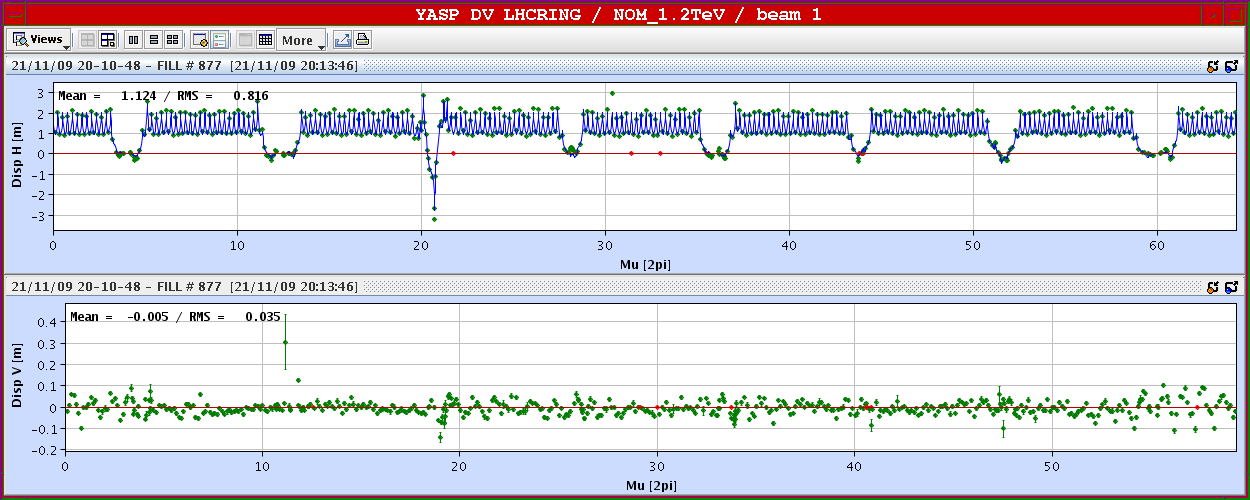
The LHC team just completed testing of the circulation of a beam in both directions. Apparently it looks good. I think the idea now is to slowly ramp up in speed and duration of beam to make sure everything is going well.
More detail here.

Tuesday, October 27, 2009

LHC gets first beams

First proton beams hit a couple of sections of the LHC. Full ring traversal in November.
You go girls!

Tuesday, May 26, 2009

Do you Boinc?

I BOINC.
BOINC is a platform for distributed processing. For example, it takes a lot of processing time to sift through radio signals from the whole sky looking for possible alien signals, like it takes a lot of processing time to test various iterations of mathematical models to see what fits physics data the best. You can volunteer your PC to work for these projects when it is idle, and your PC is idle really, most of the time.
I volunteer for the following projects:
Einstein@Home - search for pulsars
LHC@Home - help develop particle accelerator physics
SETI@Home - search for alien radio signals
Cosmology@Home - match math models to physics data

As you may know, I have an awesome PC with 8 virtual cores and 6Gb RAM :_)
Here's a picture of BOINC using it hard.

You can see most of the processors are close to max (it often does max them all) and RAM usage dip suddenly as I logged on to actually use the machine.
Here's the BOIC control screen:

You can see the actual project tasks that are running, ready to run, finished and waiting for RAM allocation.
This is all very cool, but it also keeps my office toasty warm in the winter.

[update - Rosetta@Home also seems very worthy - thanks Rich]

Wednesday, April 15, 2009

Jupiters L4, L5

Check this very cool animation of some asteroids orbiting within Jupiter's L4 and L5 lagrange points. The yellow dot at the top is Jupiter, and the fast green on in the middle is Earth. See how huge an area Jupiters L4 and L5 occupy! I assume the main rotating circle of asteroids is the asteroid belt. You can also see the glomming of asteroids around Jupiters L3 as well.
Linked from here.

Tuesday, March 31, 2009

Fusion net energy gain

The physicists at NIF have finished building their fusion reactor. They hope to produce more energy from the fusion reaction than required by the lasers to start it. Awesome.

Monday, March 30, 2009

Star Wars Exhibition

We had a great day today, having taken the kids out of school and going into the Powerhouse Museum to see the Star Wars exhibition. It was pretty cool. There were loads of costumes on display, the 8ft tall Wookie costumes looked awesome. And the Wampa - that was really cool. Also there were loads of large models of spacecraft and actual lightsaber props and other weapons. The kids enjoyed the various hands on science areas such as robot kits, maglev train sets and an actual hovercraft you could sit in and drive in a circle.
We also had lunch in Darling harbour and rode the monorail through the city. The kids had a ball, and well, so did I.